|
|
Articles
Preparing to Breastfeed
Almost all women are able to breastfeed with a bit of guidance, support and
instruction. While you are pregnant, speak to your doctor or a lactation consultant
about any concerns or questions you may have. This is also a good time to find
out whether you have flat or inverted nipples, a condition that may initially
make it difficult for a baby to latch on correctly. To find out if your nipples
are flat or inverted, have your doctor do a breast exam (ideally, in your first
trimester) or check the response of your nipple using the following do-it-yourself
test:
A Simple Nipple Test
- Place your thumb and index finger on the areola (the dark area surrounding
the nipple).
- Behind the base of the nipple, compress gently but firmly.
- Your nipple should remain erect or protrude forward.
- If your nipple flattens or retracts (inverts) into the breast, you have
a flat or inverted nipple.
|
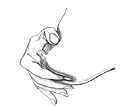
A normal nipple remains erect |
| Note—It is important to do this "pinch test" because, although
some nipples appear erect, some may invert when the areola is compressed. |
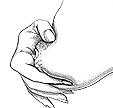
An inverted nipple. |
| If you have flat or inverted nipples, the condition may improve automatically
during pregnancy. If the condition has not improved by the mid-point of your pregnancy,
speak to your doctor. Breast shells (plastic shells that are worn under the bra)
may draw out the nipple. After birth, if your baby still has difficulty attaching
to your breast, speak to your doctor or a lactation consultant. |

A flat nipple. |
Photos used with permission of Medela, Inc.
Copyright © 1999 Medela
This publication is for general informational
purposes only and it is not intended to provide any reader with specific authority,
advice or recommendations. Where you deem necessary, we suggest that you seek
advice regarding your particular situation from the appropriate professional.
Copyright© 2001, LifeCare®, Inc.
P.O. Box 2783, Westport, CT 06880.
|
|
 |


